Method 1 - Using Client Secret
Enabling mail retrieval registering with Microsoft identity platform
To retrieve mails from outlook using OAUTH2 Client Secret based Authentication, obtain client_id,tenant_id,client_secret.
Follow the below links for the steps to accomplish the corresponding tasks:
-
To register your application with Azure Active Directory:
https://learn.microsoft.com/en-us/azure/active-directory/develop/quickstart-register-app
. Use the Client Secret Method.
-
To provide API permissions to your application and create a service principal to provide access to mailboxes: https://learn.microsoft.com/en-us/exchange/client-developer/legacy-protocols/how-to-authenticate-an-imap-pop-smtp-application-by-using-oauth#use-client-credentials-grant-flow-to-authenticate-imap-and-pop-connections .
Configuring the component
Managed Connection Factory
-
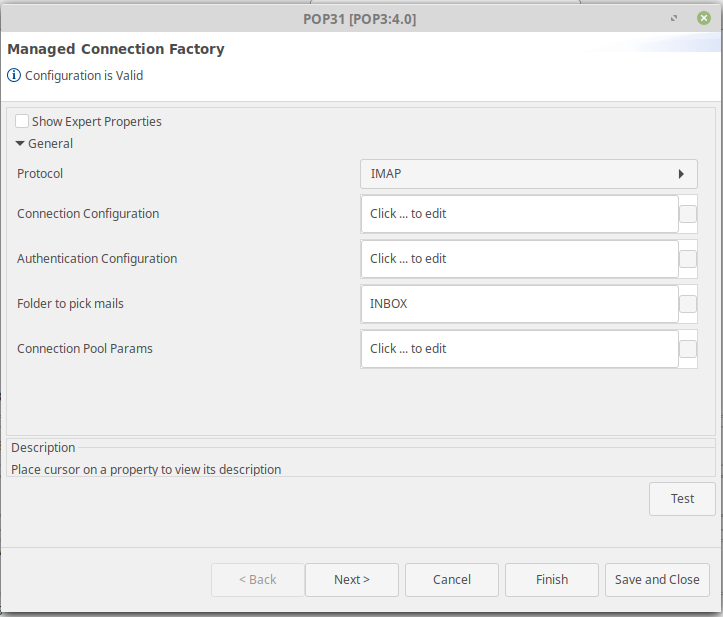
Select the "IMAP" option from the Protocol drop-down.
-
Under Connection Configuration, provide the following property values:
-
MailserverURL: outlook.office365.com
-
MailServer Port: 993
-
-
Provide the following additional properties:
-
mail.imap.starttls.enable = true
-
mail.imap.socketFactory.class = javax.net.ssl.SSLSocketFactory
-
Authentication Configuration
OAUTH2 is a token-based authentication which uses access token to authenticate mail server.
Post request URL for requesting access token from Microsoft server using client secret in the following format:
POST /{tenant}/oauth2/v2.0/token HTTP/1.1
Host: login.microsoftonline.com
Content-Type: application/x-www-form-urlencoded
client_id=535fb089-9ff3-47b6-9bfb-4f1264799865
&scope=https%3A%2F%2Fgraph.microsoft.com%2F.default
&client_secret=sampleCredentia1s
&grant_type=client_credentials
Testing the configuration
-
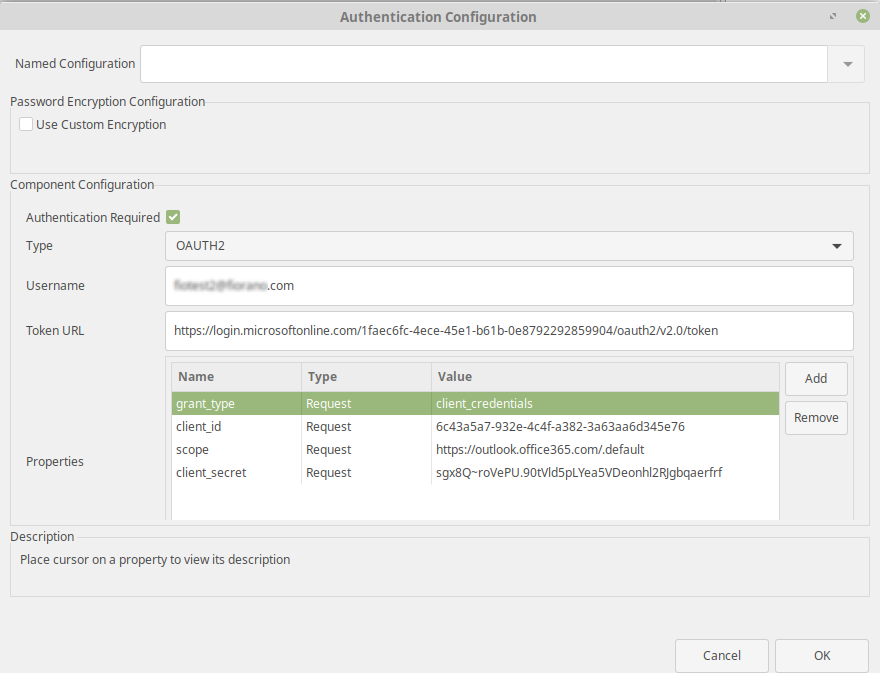
Select OAUTH2 as Authentication Type
-
Username - Mail Id that is associated with Azure Active Directory
-
Token URL - URL should be of the following format
https://login.microsoftonline.com/TENANT_ID/oauth2/v2.0/token
Here TENANT_ID, is replaced with Directory(tenant)ID that is obtained from Azure Application
-
-
Add the following Request Properties:
-
grant_type = client_credentials
-
client_id = Application(client)ID value that is obtained from Azure Application
-
client_secret = Replace with secret value obtained from azure application
-
-
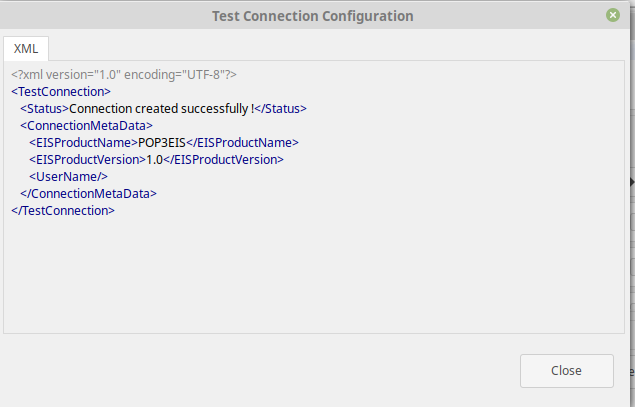
Test the connection using Test button in Managed Connection Factory.
Method 2 - Using Client Certificate
Generating certificate and private/public keys
Certificate and Private Key
Enter the following command to generate Certificate and Private Key using OpenSSL tool:
openssl req -x509 -sha256 -nodes -days 365 -newkey rsa:2048 -keyout privateKey.key -out certificate.crt
Enter the DN information upon prompting.
Public Key
To generate public key from (.crt) certificate, use the following command:
openssl x509 -pubkey -noout -in certificate.crt > pubkey.pem
Enabling mail retrieval registering with Microsoft identity platform
To retrieve mails from outlook using OAUTH2 Client Certificate based Authentication, obtain client_id,tenant_id,certificate thumbprint
-
Follow the steps mentioned
https://learn.microsoft.com/en-us/azure/active-directory/develop/quickstart-register-app
to register your application with Azure Active Directory. Use Client Certificate Method. Upload the .cer certificate file and note down the Certificate Thumbprint value.
-
Follow the steps mentioned
https://learn.microsoft.com/en-us/exchange/client-developer/legacy-protocols/how-to-authenticate-an-imap-pop-smtp-application-by-using-oauth#use-client-credentials-grant-flow-to-authenticate-imap-and-pop-connections
to provide API permissions to your application and Create a service Principal to provide access to mailboxes.
Generating Access Token
For certificate-based authentication, use the REST API for getting the access token in the following format:
POST /{tenant}/oauth2/v2.0/token HTTP/1.1
Host: login.microsoftonline.com
Content-Type: application/x-www-form-urlencoded
scope=https%3A%2F%2Fgraph.microsoft.com%2F.default
&client_id=97e0a5b7-d745-40b6-94fe-5f77d35c6e05
&client_assertion_type=urn%3Aietf%3Aparams%3Aoauth%3Aclient-assertion-type%3Ajwt-bearer
&client_assertion=eyJhbGciOiJSUzI1NiIsIng1dCI6Imd4OHRHeXN5amNScUtqRlBuZDdSRnd2d1pJMCJ9.eyJ{a lot of characters here}M8U3bSUKKJDEg
&grant_type=client_credentials
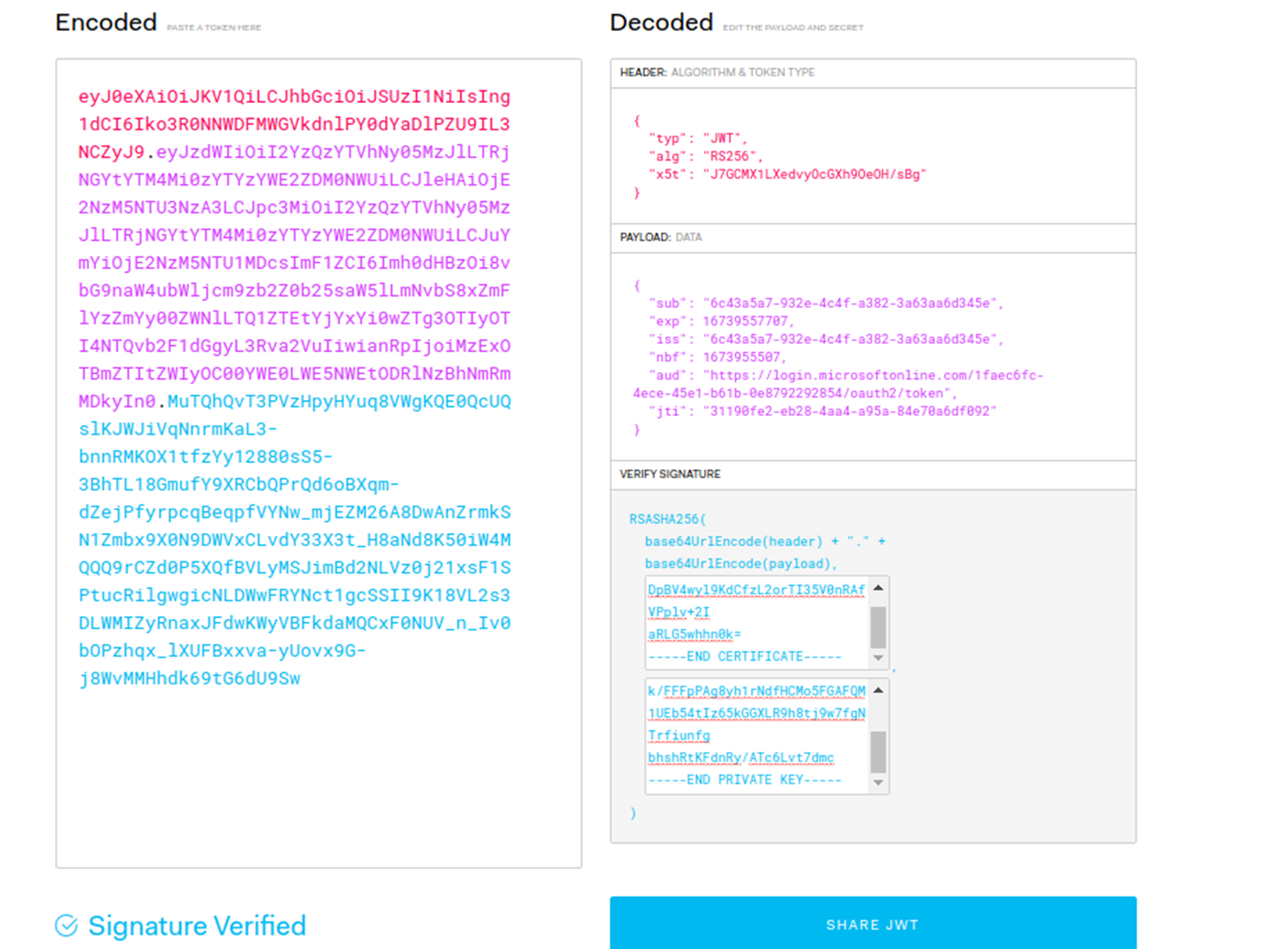
Here, client_assertion is an encoded JWT Token signed with private key using RS 256 algorithm
Creating client_assertion JWT Token
Use https://jwt.io/ for generating the JWT token.
Header
|
Name |
Description |
|---|---|
|
alg |
RS256 |
|
typ |
JWT |
|
x5t |
Base64url-encoded SHA-1 thumbprint of the X.509 certificate's DER encoding. Use https://base64.guru/converter/encode/hex to convert the Certificate Thumbprint Hex string to Base64. This converter tool decodes the Hex string into its original data, then encodes it to Base64. Remove any trailing = characters
|
{
"typ": "JWT",
"alg": "RS256",
"x5t": "J7GCMX1LXedvyOcGXh9OeOH/sBg"
}
Claims (payload)
|
Name |
Description |
|---|---|
|
aud |
https://login.microsoftonline.com/{tenantId}/oauth2/v2.0/token |
|
iss |
{ClientID} |
|
exp |
expiration time after which jwt is not accepted 16739557707 |
|
jti |
a unique identifier for the JWT |
|
sub |
{ClientID} |
|
nbf |
time before which the JWT is accepted for processing 16739555707 |
{
"sub": "6c43a5a7-932e-4c4f-a382-3a63aa6d345e",
"exp": 16739557707,
"iss": "6c43a5a7-932e-4c4f-a382-3a63aa6d345e",
"nbf": 1673955507,
"aud": "https://login.microsoftonline.com/1faec6fc-4ece-45e1-b61b-0e8792292854/oauth2/token",
"jti": "31190fe2-eb28-4aa4-a95a-84e70a6df092"
}
Signing JWT Token
Sign the JWT token using Private key and Public key generated using the OpenSSL tool.
The encoded format of JWT Token gives the client_assertion
Configuring the component
Managed Connection Factory
To configure the component, follow the same steps mentioned in the Managed Connection Factory section under the section.
Authentication Configuration
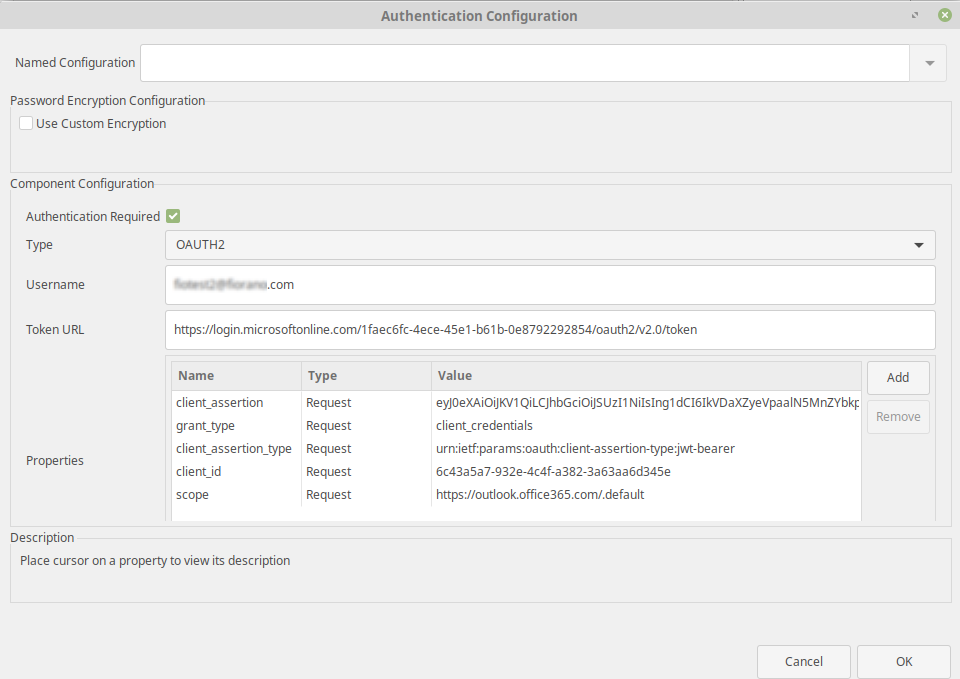
In Authentication Configuration window, replace client_secret property with
-
client_assertion_type = urn:ietf:params:oauth:client-assertion-type:jwt-bearer
-
client_assertion = the encoded JWT Token