
To clear the FES server database of the default profile (that is profile1), double-click the clearDBServer.bat file present in the <fiorano_installation_dir>\esb\server\bin folder or browse to this location and execute the following script:
script clearDBServer.bat/.sh -mode fes
To clear the FES server database of a specific profile (other than the default profile), double-click the clearDBServer.bat file present in the <fiorano_installation_dir>\esb\server\bin folder or browse to this location and execute the following script with the profile option as shown below:
clearDBServer.bat/.sh -mode fes -profile <profilename>
The following operations are available when this script is executed from which you may choose the option of your preference:
|
Operation |
Description |
|---|---|
|
1. File BasedDatastore |
Clears the local cache of the Enterprise server. |
|
2. Admin Datastore |
Clears the admin objects, that is, JMS Connection factories, queue and topic destinations, status of running Event Processes and component instances. |
|
3. Peer Repository |
Clears all the fetched peer server profiles from Enterprise Server runtimedata. |
|
4. Events Database |
Clears the Events Database using the configurations provided in eventsdb.cfg file present under: <fiorano_installation_dir>/esb/server/profiles/<profilename>/FES/conf directory. |
|
5. SBW Database |
Clears the SBW database using the configurations provided in the sbwdb.cfg file present under: <fiorano_installation_dir>/esb/server/profiles/<profilename>/FES/conf directory.
|
|
6. Events Persistent Database Cache |
Clears the temporary persistent datastore of system events. |
|
7. SBW Persistent DatabaseCache |
Clears the temporary persistent datastore of SBW events. |
|
8. SBW Call Out Persistent DatabaseCache |
Clears the temporary persistent datastore of SBW Callout events. |
|
9. Backlog Persistent DatabaseCache |
Clears the temporary persistent datastore of backlog events. |
|
10. YAWL Database |
Clears the YAWL Database for the Enterprise Servers. |
|
11. All |
Clears all nine of the above. |
Select the preferred number (from 1 to 11) corresponding to the datastore that needs to be cleared.
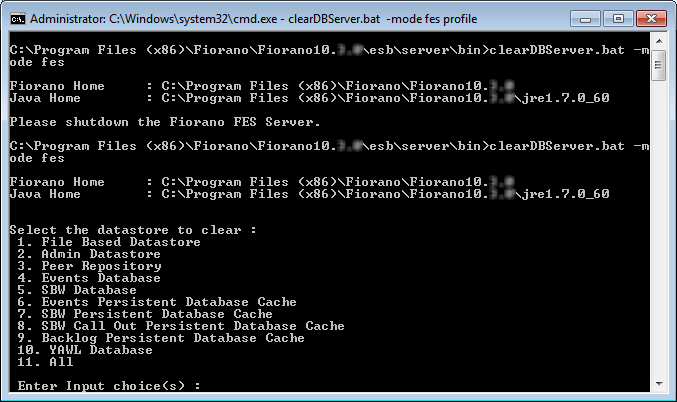
Figure 2: Options to clear datastore
Ensure that the Enterprise Server is shut down. If not you will get a message prompting to do the same (as in the figure above—"Please shutdown the Fiorano FES Server")
The script can be executed in Quiet Mode as follows (sample):
clearDBServer.bat -mode fes -profile profile1 -dbPath <DB Directory path> -q 1,2,4
where, the elements included implies as below:
-
-mode - to clear fps or fes runtimedata
-
-dbPath - runtime data directory for the profile
-
-profile - profile name for which runtimedata is to be cleared
-
-q - to run the script in quiet mode.
You can provide comma separated option values to the argument (as in the above sample script). Absence of an argument leads assuming the default option—option 11, ‘ALL’.